Debunking myths on genetics and DNA

Monday, May 26, 2014

"Writing was my first and strongest love": author Jason Gurley talks about books, readers, and the wonder of science


What do Hugh Howey and Matthew Mather have in common? Yes, they are all in the top 10 Amazon authors, but they have something, actually somebody else in common: the uber talented Jason Gurley designed their book covers. But wait, Jason is not just a designer: he's also a successful writer, with four published novels and a fifth about to be released next month. Jason has designed book covers for Amazon Publishing, Subterranean Press, Prime Books and many independent authors, among them bestsellers Hugh Howey, Matthew Mather, Russell Blake, Michael Bunker, Ernie Lindsey and others. And by book covers I mean stunning artwork, just check out Jason's gallery for a sample. I love how with "just" an amazing texture and a beautiful font, Jason can make a stunning cover.

Jason has been publishing his novels for a little over a year now, and his next novel, Eleanor, is due for release on June 27, but you can preorder it now and get the digital copy for free via Kindle MatchBook. Wait, it gets better: you'll get a free ARC copy if you sign up for Jason's newsletter before June 16!

There's a reason why Jason is so generous with his readers -- when asked why he chose to self-publish rather than going through the traditional path, his reply touched my heart:
"Self-publishing‚ or indie publishing, however you want to refer to it, actually leads to publication. For most authors, including me, the traditional route has only led to dead ends and rejection and heartache. Self-publishing, on the other hand, leads to readers, which are all I have ever wanted. And I have fabulous readers. Very few people know who I am, or what I write, and that's okay, because the little group of those who do are wonderful and supportive and just the nicest people. I love them. And I'd never have met them if I hadn't decided to go this on my own."
(You can find the full interview by Lesley Smith here.)
Beautifully said, Jason! The one thing us writers want the most is readers. Indie publishing has allowed us to find readers. Readers make our stories come alive and they give back their wonderful feedback. This is truly the most rewarding thing a writer can ask for.

I'm digressing. What I really should be saying at this point is how honored I am to have Jason as a guest today on CHIMERAS!

EEG: Tell us a bit about yourself: you are a design artist, a writer, a husband, a father ... what's your background? Did you come to visual art and writing from different routes?

JG: As I recall, I stumbled into design by way of writing. Though as a kid I always imagined I'd work for Disney or something, I never really pursued a career in the visual arts. Writing was my first and strongest love. The design career came from that. I took a job copy editing on websites, and one day the designer I worked with called in sick. There was a minor design emergency, so I opened Photoshop, learned enough to fix the problem. . . and I haven't closed Photoshop in 15 years.

EEG: You just released the short story collection Deep Breath Hold Tight, your fifth novel, Eleanor will be released next month, and your first novel, published a little over a year ago, The Greatfall is an Amazon bestseller! What's the secret for being so successful and prolific at the same time?

JG: Well, 'successful' is relative, isn't it? I've given away far more books than I've sold, by a rather large margin. For now I don't worry all that much about sales, though. I don't rely on my books to pay the bills. I have a very fulfilling design career, and I write because I just enjoy telling stories, and having people read them.

As for popular -- I'd debate that one with you! I'm fortunate to have a passionate group of readers who seem to enjoy the work I've published -- though I would never take for granted that I've 'earned' them. Every book is an opportunity to disillusion a reader, or capture the heart of a new one. I take that seriously.

I define success a little differently, I suppose you could say. For me, it's all about knowing people are reading and enjoying the stories I tell, no matter how they come by the books. Eighteen months ago, that number was zero. Now, if you count every person who has bought a book and every person who has gotten one for free, there are probably close to a hundred thousand people who have my books close at hand, whether on a shelf or beside their bed or hanging out on their e-readers, waiting for a spare moment.

Of course, that doesn't mean a hundred thousand people have read my books. Not by a long shot. I download books like a fiend on my iPhone, and sometimes they sit there for a year before I work my way down the list to them. But I like that thought as well. Someone who downloaded The Man Who Ended the World today might not read it until 2015. There's no more shelf-life. Books are rapidly becoming forever.

EEG: You started writing Eleanor 13 years ago, and I know it's been a labor of love: tell us about the book and the inspiration behind it.

JG: A labor of love, most definitely. An exercise in frustration? That, too. It's hard not to both love and despise a book when you've spent that much time on it. You love it for what it means to you; you resent it for taking over your life. I'm both thrilled and enormously relieved to finish it.

I've alluded here and there to the backstory of this book and how it came to be. The book emerged during a time of personal reflection. I was twenty-three years old. I'd written three novels that weren't great -- weren't awful (well, maybe one of them was), but weren't going to light anybody up. I wasn't hopeful about my writing career panning out. Things were different then. Self-publishing was expensive and there was a greater stigma attached to it than there is now, so my option was the traditional publishing path, and that's a thorny gauntlet.

Personal reflection, though: I should mention here that my father is a Pentecostal minister. His brother is, too. I went to a Bible college, where they tried to turn me into a preacher. I lasted a single semester. My family history was thoroughly steeped in the Pentecostal church. A man named A.D. Gurley was involved in the founding of the Pentecostal church and its early doctrines. As I understand it, we're related somewhere in the branches of my family tree. A much more distant relative, Phineas Gurley, was the chaplain of the U.S. Senate in the 1800s, and also Abraham Lincoln's pastor and eulogist.

That's a lot of history to consider when your own belief system seems to have faltered. At twenty-three I started asking questions that I'd always wondered about but never vocalized. I wasn't sure if I believed in a god, and that was a problem. It contributed to the end of my first marriage. It resulted in the loss of friends. But it also birthed Eleanor.

In the beginning Eleanor was a very different book. In retrospect, it was clearly a vehicle for some big questions I was asking, and some challenging decisions I was making in my own life. For several years, it was a story about a girl who met God while she was comatose, and after waking from her coma, spent her life trying to replicate the experience. The book was literally asking whether or not a god existed, and I was going to use it to try to answer that question for myself.

I'm thirty-five now, and this is Eleanor's thirteenth year, and it's long since abandoned those early questions. I've answered a lot of those for myself, and they're not gnawing at me the way they were when I was younger. That's really released the book from the burden of what it was trying to do, and allowed Eleanor to find her own story.

And her own story is really marvelous. Eleanor is about mothers and daughters, not gods or belief. It's about family tragedy, and finding a way to set right the kinds of wrongs that echo for decades. It's about time, and leaps of faith, and worlds that crash into each other in a very real and literal sense. I've been floored by a few readers and other authors who have compared the book to Neil Gaiman's wonderful The Ocean at the End of the Lane, or Madeleine L'Engle's A Wrinkle in Time. Floored. Those books are perfect examples of fantasy and reality blurring the lines of a young person's life, and it's really moving to hear people suggest that my book belongs in the same breath as those masterpieces.

EEG: That's really intriguing, I can't wait to read Eleanor! On a side note, I finished my first novel after I decided the God I'd been raised with wasn't really "my" God. I've often thought about that and I don't think it was a coincidence. But I'm digressing, again. Will Eleanor be part of a series?

JG: Eleanor is that all-time classic — the stand-alone novel. It’s always been that, except for a brief foray into graphic novel-dom (still visible here, though the novel is vastly, vastly different). I toyed with the idea of turning it into a serial novel last fall, and quickly shot that down when beta readers pointed out that there were no logical break-points in the story that wouldn’t infuriate readers. So: It’s a novel, and one that’s grown a little bigger with editing, and it would be nice to write one or two books like this one every year.

EEG: What other books are on your burner, then?

JG: Well, Eleanor is the big one — it’s the culmination of many, many years’ worth of starts and stops, writing vacations, all-night outlining marathons, massive overhauls and redesigns, and now with it on the verge of release… Let’s see. Next up is The Travelers, the final book in a sci-fi trilogy that I began last year. That should be a lot of fun, and a much faster affair than Eleanor, by far. I’m also quite privileged to have been invited to contribute short stories to a few anthologies — Synchronic, a time-travel anthology edited by David Gatewood, has just come out, and in July I’ll be in John Joseph Adams’s Help Fund My Robot Army!!! You’ll know my story because it’s the one not written by someone famous. (Though I did design its cover, and it’s quite nice.)

EEG: Whaddya know, you'll be famous by then! ;-) Your book covers are stunning: when did you start making book covers, and is it something you enjoy just as much as writing, or is it a diversion, rather?

JG: You know, it's both. I really love making book covers — but I also love writing my own stories. And when you're a husband and a father and you have a full-time career that you enjoy, there's only so much you can give your free moments to. So I'm learning how to give all of my limited creative time to the thing I love most -- writing books -- and slowly diminishing my cover work. I'll probably still produce the odd book cover here and there, but if I'm successful you'll hear my name less in reference to design, and hopefully more in reference to good stories.

And to answer your first question, I started making them with my own first book, The Man Who Ended the World. After a few really lovely covers of my own, I started doing them as favors for some author friends. And then Hugh Howey came along, and gave me a chance to design some beautiful wraps for his own terrific stories, and that changed everything!

EEG: Oh no, then I have to hurry up to order my next book cover! ;-)

Do you find science inspiring for your work?


JG: I love science. I really, truly do. But I love the wonder of science more. I love the feeling that I get when my family and I drive to my parents' house -- they live in the Washington woods -- and as everyone goes inside, I stand outside under the stars and just stare. It's so utterly black out there, and the stars are just crisp. I watch them for awhile before I remember to unpack our bags from the Jeep.

That sense of wonder is important to me, and it's more important to me than hard science, at least when it comes to writing. I'm sure many of the things that happen in my books can be refuted or corrected by someone who knows more about science than me. My friend and fellow novelist Peter Cawdron often educates me about this, pointing out how the things I write about would really work. I don't worry so much about those kinds of details, and they don't bubble up to the surface in my work all that often, because I try very hard to tell stories about humans, about emotions. As one of my readers would explain, there's not always a lot of pew-pew in my stories, but there are plenty of feels.

I love movies like this, too. There are some really wonderful character-driven stories that taken place against a backdrop of science fiction, rather than pushing science to the foreground. Her is a good recent example. Another Earth is one of my favorites. You could consider Moon or Upstream Color or even Safety Not Guaranteed to be examples of this, too. There's no real term for this kind of story, unless I've missed it. I call it 'quiet' science fiction, for lack of a better word -- stories in which the technical aspects of the story only occupy the foreground when it's necessary, leaving plenty of room for the emotional weight of the characters and their journey to fill the space.

EEG: "Feels" is what makes a great story. I know I've read a great book when I keep thinking about the emotions the story stirred as I read through.

Thanks so much for sharing your thoughts with us today, Jason! You can find out more about Jason's books and book covers on his website, Facebook, and twitter. Go preorder your copy of Eleanor and don't forget to sign up for Jason's newsletter, you'll get books for free!

Saturday, May 24, 2014

MOSAICS SnippetSunday #8


From MOSAICS, Chapter 1:
Satish started the engine and backed out of the driveway. “Shit happens, Track. Never forget that.”
“Hard to forget on days like this.”
I rolled down the window and let cool air blow in my face. The freeway droned in the distance, as another night descended upon L.A. Another murder, another killer on the loose.
It was June 2009, the beginning of summer.
Killing season had just started.

The above is my Sunday snippet submission for the Weekend writer Warriors (you can find the Snippet Sunday group also on Facebook, too). Check them out, it's a fun way to find upcoming books -- all genres welcome, there's something for everyone's tastes.

And now to some exciting news:

MOSAICS, Book 2 in the Track Presius mystery series is coming September 2014. Many thanks to my awesome beta readers who provided insightful feedback. Of course, before you sink your teeth in MOSAICS, you should first read CHIMERAS, right? ;-)

Book DescriptionDubbed the Byzantine Strangler because of the mysterious mosaic tiles he leaves at the crime scene, a new serial killer is stalking the streets of Los Angeles. Racing to decipher the code encrypted in the tiles before the killer strikes again, Detective Track Presius faces a new challenge: the "awakened" genes that make his vision and olfactory sense so sharp are now taking a toll on his life. When a new set of tiles appears in his own backyard, Track makes a chilling realization: those very same genes that are threatening his life are drawing the Byzantine Strangler closer and closer. The fine line between hunter and hunted has suddenly blurred. Will Track be the next piece of the mosaic puzzle?

Don't want to miss the release day? Sign up for the newsletter (2-3 times a year) and receive a free desktop wallpaper of the Southwest as a thank you. Click here to subscribe. Also, just like I did with CHIMERAS, I am offering ARCs (advance release copies) in exchange for an honest review to be posted on Amazon: please sign up here if interested. ARCs will be ready in July. E-book format only, sorry.

Friday, May 23, 2014

"Ideas are born from the mind": speculative fiction author Cherie Reich talks about her debut novel Reborn


Today's author interview is for an exciting new release from speculative fiction author Cherie Reich. Cherie is a "self-proclaimed bookworm" and library assistant based in Virginia. Her debut novel Reborn follows the story of Yssa, the Phoenix Prophetess at the Temple of Apenth. The book came out on May 9 and already has raving reviews.

Congratulations, and welcome to CHIMERAS, Cherie!

EEG: You are a writer and a librarian: is working in a library a dream come true for a writer?

CR: I can honestly say I would never have become a writer without working the job I do. I work in a small academic library, and I sometimes have a lot of free time at work. Since I needed something to do, I decided to write a novel (i.e. Reborn) that’d been in my head for years. I have never looked back.

EEG: What are your favorite choices when it comes to reading?

CR: Oh, I enjoy many types of books, from fantasy to mysteries to horror to romance. I enjoy Young Adult to Adult. I prefer fast-paced tales that keep you reading to the last page.

EEG: Tell us about your YA epic fantasy Reborn: what was the inspiration for the book and series? And what about the series, The Fate Challenges: how many books will there be?

CR: The premise of a stillborn girl reborn by a god and given the gift of prophecy came to me for a character for a Harry Potter roleplaying game. The idea of such a character clung to me, and thus, Yssa and her world were born from that premise. For The Fate Challenges, there will be four novels and two novella-length works. Reborn, Reforged, and Redestined are the main trilogy revolving around Yssa’s story. Repledged and Reigned are prequel stories set at 800 and 500 years before Reborn, respectively. Remarked is a story set between Reborn and Reforged and will be told from Liam’s point of view.

EEG: As a librarian, do you have any thoughts to share on the future of books and the publishing world?

CR: It’s an exciting yet turbulent time in the book world. Libraries are adapting, and publishers must do so to keep up. I think that’s what is so great about self-publishing. We can afford to change things up and try new things, instead of the same ol’ same ol’. I believe books are here to stay, even though they may look different than they had in the past.

EEG: Where are your stories conceived: in your head, on a blank piece of paper, on the computer ...?

CR: Ideas are born from the mind. Mine often dwell in my head for months and even years until I take them from my mind and type up an outline of what they will become on my computer.

EEG: I "brew" my characters in my head for years too. I think it's a good thing that authors spend quality time with their characters and get to know them better before they jump into the story. Thanks so much for being with us today, Cherie, and best of luck with your writing!

CR: Thanks for having me, Elena!

You can find Reborn on Amazon, Goodreads, Google Play, and Kobo. For a full list of retailers visit Cherie's website and blog.


Wednesday, May 21, 2014

The Human Knock-out: looking for non-working genes

© EEG

The word "knock-out" in biology is used for lab animals like mice, for example, when one of their genes is silenced in order to study the effects of not having that gene. Silencing a gene (or knocking it out, hence the nomenclature "knock-out mouse") means that gene is no longer producing the protein it codes for. This is a condition sought for in situations where you have to test for a drug and hence the first step is to reproduce the genetic condition that caused the disease.

Mice are often "humanized", i.e. genetically engineered to carry human genes so that the experiment can be a better model for drug or therapy testing. Unfortunately, even when humanized, mice or lab animals in general are poor models for humans. When things don't work out in an animal model, we know that the experiment should not be carried out on to humans, but when on the other hand things go well in an animal experiment, there is no guarantee that it will work on humans too.

"Human chip" technology is a very promising solution, as it would bypass the need of animal testing for drug discovery. The idea is to have cell cultures from different organs on a "chip" the size of a smart phone. Lung, liver, kidney chips have already been designed and tested, but lately there has been an even further advance in making the chips part of a network connected by "blood vessels": Athena (Advanced Tissue-engineered Human Ectypal Network Analyzer) is an ongoing project to see how four organ chips (liver, lung, heart and kidney), connected by tubed filled with artificial blood, can effectively simulate a human body for drug testing and toxin screening. Athena, also dubbed the "desktop human" as given its size it would conveniently sit on a desktop, is a $19 million dollars project that will be built in the next five years.
You can read the full story here.

Athena, however, only has four organs and is still poor surrogate of the human body. The ideal solution would be to have human knock-outs to study the true effect of drugs, which of course is a little unethical to pursue. Unless human knock-outs already exist in nature. Well, guess what? They do, and they are far more common than we originally thought: on average every person has about 20 inactivated genes [1]. Wait, it gets better. Because, you may wonder, if they are so common, how come we never noticed? The ~20 inactivated genes must have some effects and/or symptoms, right?

Not necessarily. Yes, that's the most amazing thing: how robust our DNA is. People can have inactivated genes and still be healthy. It doesn't always happen, yet there are some cases when deficient gene copies are somehow compensated by other genes. And that's exactly why studying these human knock-outs is so relevant: we need to understand how people can stay healthy even when lacking important genes, as this can give new insight in drug discovery and therapy development.

In [1], MacArthur et al. screened close to 3,000 variants predicted to cause loss of gene function from 185 human genomes. Then challenge is to distinguish the "true" loss of function variants from sequencing errors. The researchers designed a "filter" to distinguish the "true" variants from the artificial errors. To me, the most striking discovery they made is that loss of function doesn't work as an "on/off" switch, rather, it can lead to a range of possible scenarios:
"Homozygous inactivation of a gene can have a range of phenotypic effects: At one end of the spectrum are severe recessive disease genes, while at the other end are genes that can be inactivated with- out overt clinical impact, referred to here as LoF- tolerant genes. Clinical sequencing projects seeking to identify disease-causing mutations would benefit from improved methods to distinguish where along this spectrum each affected gene lies [1]."
Jocelyin Kaiser wrote a nice article on Science [2] on the recent developments of this type of research: the plan is to sequence the genome of many more "healthy" people, find what genes they have inactivated, and then study their clinical characteristics. Some of these loss of function variations may end up being beneficial, as is the case for PCSK9, for example: the gene encodes for the homonymous enzyme, which has been associated with high cholesterol. As it turns out, individuals who carry loss of function mutations in this gene have low cholesterol and a significantly reduced risk of stroke and heart disease [3].

[1] MacArthur, D., Balasubramanian, S., Frankish, A., Huang, N., Morris, J., Walter, K., Jostins, L., Habegger, L., Pickrell, J., Montgomery, S., Albers, C., Zhang, Z., Conrad, D., Lunter, G., Zheng, H., Ayub, Q., DePristo, M., Banks, E., Hu, M., Handsaker, R., Rosenfeld, J., Fromer, M., Jin, M., Mu, X., Khurana, E., Ye, K., Kay, M., Saunders, G., Suner, M., Hunt, T., Barnes, I., Amid, C., Carvalho-Silva, D., Bignell, A., Snow, C., Yngvadottir, B., Bumpstead, S., Cooper, D., Xue, Y., Romero, I., , ., Wang, J., Li, Y., Gibbs, R., McCarroll, S., Dermitzakis, E., Pritchard, J., Barrett, J., Harrow, J., Hurles, M., Gerstein, M., & Tyler-Smith, C. (2012). A Systematic Survey of Loss-of-Function Variants in Human Protein-Coding Genes Science, 335 (6070), 823-828 DOI: 10.1126/science.1215040

[2] Kaiser, J. (2014). The Hunt for Missing Genes Science, 344 (6185), 687-689 DOI: 10.1126/science.344.6185.687

[3] Cohen, J., Pertsemlidis, A., Kotowski, I., Graham, R., Garcia, C., & Hobbs, H. (2005). Low LDL cholesterol in individuals of African descent resulting from frequent nonsense mutations in PCSK9 Nature Genetics, 37 (2), 161-165 DOI: 10.1038/ng1509

ResearchBlogging.org

Monday, May 19, 2014

Patrice Fitzgerald on how to be a successful author: "Write the best book you can"


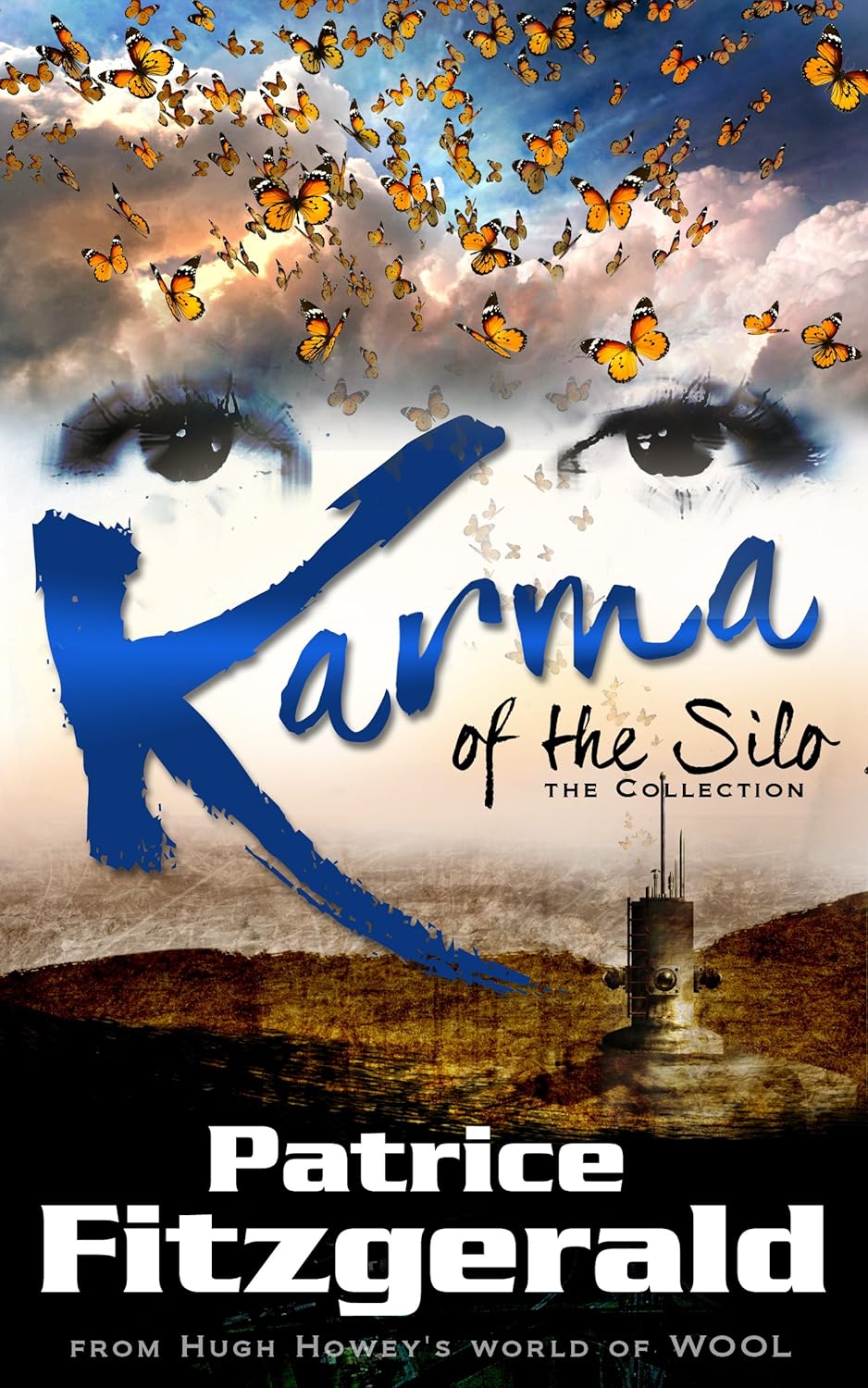
My guest today is author Patrice M. Fitzgerlad, a sci-fi, political thriller, and mystery writer who has a past as an intellectual property attorney. Patrice, who is also a professional mezzo-soprano in her spare time, debuted the publishing world with the political thriller Running, and currently has a bestselling series titled Karma of the Silo.

Welcome to CHIMERAS, Patrice!

EEG: Your Silo stories are a great success, congratulations! Tell us about the world these stories are set in and how you got the idea.

PMF: I was so inspired by Hugh Howey's WOOL, like the two million+ people around the world who have read it by now, that I wanted to stay in that scary, challenging, fascinating universe. I started writing the Karma series set in the Silo after I read the first part of his SHIFT, which is the second in Howey's Silo Saga trilogy, and the one that gives us the "how did we get here" piece of the story. That was the part I found most compelling.

As soon as I found out that Hugh was cool with others writing in his world, I started doing just that. I chose a character that was introduced by Hugh but was kind of a "loose end" and I told her story‚ which is now the full novel Karma of the Silo: the Collection. And it has become a bestseller! Which is tremendously exciting.

EEG: What tips do you have for independent writers who are just about to put their books out there?

PMF: It's the best job ever, but one of the most challenging. Definitely not a get-rich-quick scheme. More of an "open your own business, work your buns off, and hope for the best" situation. Here are the steps I prescribe for new indie writers:

1. Write the best book you can.
2. Edit it to the standards of traditionally published books.
3. Get a fantastic cover -- it's worth it.
4. Format it so that it looks professional.

But none of that guarantees success, and no success is possible without having a really good book. So write your first one, do all the above, and then put your head down and write the next. And the next. The more books you have out there the better chance you have of getting discovered, and if you are discovered and you have a number of books, you will actually then make money!

EEG: The Karma series is science fiction, yet the first book you published, Running, is a political thriller. Is there a genre that defines your style or do you write just about anything that crosses your mind?

PMF: I've been writing novels since 1992, and have had an agent and a TV offer and a lot of close calls‚ but never got traditionally published. My background includes a law degree, so I was first attracted to legal thrillers, back when John Grisham hit the scene, and I thought, "I can do that!" Running, which is about two women competing to be President, came out of that impulse. I also have a number of funky short stories, and I'm working on another dystopian series, a mystery series, and maybe even some erotica. (Sshh, don't tell anyone!) Who knows which of these will see the light of day?

I wouldn't say that I write about anything that crosses my mind, but I have a lot of interests and a lot of ideas, and if one seems strong enough to carry a story, I give it some attention. Not all of them have gotten published‚ yet.

EEG: Who are your role models when it comes to writing?

PMF: Hmm... Jane Austen. Hugh Howey. Ann Patchett. Michael Chabon. Lots of different influences. I try to read constantly, both in sci-fi and in general fiction, and I'm often inspired by what others write. I just finished reading The Goldfinch, which won the Pulitzer Prize, and I loved it but thought it needed some tightening, and suffered from a passive main character. The more I write the more I realize we are all just struggling to get that perfect story that exists in our minds onto the page. And to the readers. The money is nice, but it's the communication from our own fevered little imaginations to another human being that is so satisfying.

What is tremendously cool is that we're now in charge of the process‚ if we want to be. I'm an entrepreneurial type, and I enjoy being able to choose the cover art, write the descriptive blurb, decide when a book is ready, etc. Although it takes a lot of time to be your own publisher, you get to control everything. It's so fast! And if/when you hit pay dirt, you make a lot more money per sale than you do with traditional publishing. Of course, you price the books more cheaply, too.

I'm able to make a living at writing now, though I'm lucky that I have a spouse who works as well. Because of the seasonal swings in book-buying, an indie writer had better have some money saved or a fallback plan if she decides to do this full-time. I'm also a publisher for a few other writers, and those books help with the bottom line as well.

Thanks so much for the interview, Elena! I always love to chat with other indie authors, and share our excitement about this brave new publishing world with potential writers. We are only at the beginning of a revolution as disruptive as the invention of the printing press. Lots more to come!

EEG: I enjoy that too, Patrice! Thanks so much for sharing your thoughts on writing and publishing with us today!

Find out more about Patrice on her website, on Facebook, Twitter and of course on Amazon.

Saturday, May 17, 2014

Viruses and bacteria could be the missing piece in the missing heritability puzzle

© EEG
I've discussed the issue of the missing heritability before: in layman words, same mutations shared across people don't lead to the same phenotype. This is particularly true for diseases. Many whole genome studies have looked at possible associations between DNA mutations and diseases, but, alas, the mutations that have been found generally explain only 10% of the cases. This suggests that there's a lot more to who and what we are than genes alone, and that complex interactions between DNA, RNA and proteins come to play. If you've been following the blog for a while you know that I love to talk about epigenetics (so much so that \begin{plug} I wrote a detective thriller based on epigenetics \end{plug}): I do believe a good portion of the missing heritability puzzle relies on epigenetics, which studies the mechanisms that turn our genes "on" and "off". These mechanisms are not coded in our genes, yet they can be carried on for 2-4 generations.

There are other factors, besides epigenetics and complicated genetic interactions, that could explain the missing heritability. Bacteria and viruses for example could be playing a fundamental role. In a recent post I discussed a study that points at the gut bacteria as responsible for the inheritance of a propensity towards an obese phenotype rather than a lean one. Another example is Crohn Disease: there are some specific mutations that make an individual prone to the disease, yet not everyone with those mutations manifest the symptoms. A 2010 study [1] on a mouse model found that in the presence of the mutation, the disease manifested only after infection with a particular strain of MNV (murine norovirus), the mouse variant of norovirus, a family of viruses that cause viral gastroenteritis. So, rather than the mutation alone, it's an interaction between genetic predisposition and viral infection that seems to cause Crohn Disease.

In a recent study published in PNAS [2], Edwards et al. proposed an yeast model to study the interaction between chromosomal mutations and non-chromosomal elements. In the yeast case, the non-chromosomal elements were:
"... the presence or absence of the yeast killer dsRNA virus and the other was varying mitochondria among two backgrounds with distinct differences in their genome sequence. The two mitochondrial genomes we selected show considerable variation, with about two to three SNPs per kilobase between them and 10 times as many insertions and deletions per kilobase between them as found in the chromosomal genome [2]."
The researchers induced chromosomal changes in different strains of yeast expecting their phenotype to change accordingly: they examined 17 single gene deletions that induced growth defects, expecting to observe much smaller populations. It turns out that this didn't work as a "switch". In other words, the belief "you turn on the green eye gene, you get green eyes" (which, sadly, is a very common misconception that people have about genes) is a myth. Yeast bacteria don't have green eyes, of course, but the researchers saw that despite changing certain genes, they were still getting a broad spectrum of growth phenotypes. Despite having the induced mutations, whether the yeast colonies did or didn't grow depended on the presence or absence of the dsRNA virus and the variation in mitochondrial genes. With their experiment, Edwards et al. showed that
"the heritability of a trait can depend on nonlinear interactions between chromosomal and nonchromosomal information that is transmitted from generation to generation. The nonchromosomal information can interact with the various chromosomal alleles at a locus to modify phenotype significantly. [...] Our results show that the nonchromosomal contribution to heritability can be large and, in some cases, can completely mask the effect of a chromosomal mutation [2]."

[1] Cadwell K, Patel KK, Maloney NS, Liu TC, Ng AC, Storer CE, Head RD, Xavier R, Stappenbeck TS, & Virgin HW (2010). Virus-plus-susceptibility gene interaction determines Crohn's disease gene Atg16L1 phenotypes in intestine. Cell, 141 (7), 1135-45 PMID: 20602997

[2] Edwards, M., Symbor-Nagrabska, A., Dollard, L., Gifford, D., & Fink, G. (2014). Interactions between chromosomal and nonchromosomal elements reveal missing heritability Proceedings of the National Academy of Sciences DOI: 10.1073/pnas.1407126111

ResearchBlogging.org

Friday, May 16, 2014

CRYO: get ready to embark on a journey into the future with science fiction author Geoffrey Wakeling


Imagine an Earth whose precious resources are coming to an end; an Earth shriveled by pollution and global warming. Food is scarce and the weather unpredictable. The ecosystem is disrupted, species are going extinct. Survival has become impossible.

Unfortunately, this scenario is not too far off. Trees are dying and we are headed towards more and more severe droughts and extreme weather patterns. A dying Earth is not too hard to imagine, yet with his book series Cryo, science fiction author G. Wakeling sets off new hopes for human kind while remaining grounded on what consequences we are facing if we don't act soon.

G. Wakeling lives in London and, as he explains in his bio, he uses writing "as a way to escape the smog and grime." That's something I can totally relate to, and the moment I came across Rise of the Immortals (CRYO 1) and the second book in the series, A Changed World (CRYO 2), I knew I had to drag Geoff to the blog for an interview. Welcome, Geoff!

 EEG: I love that you wrote in your bio that you are "animal mad": my dad is a developmental biologist, so I grew up with toads, newts, fruit flies and stick insects. :-) What do you love the most about animals, and about your field, zoology?

 GW: I LOVE amphibians! My partner is desperate to get a vivarium... I'm pretty sure I'll cave fairly soon. So, I was that kid in school who didn't have many friends, but who DID have A LOT of animals. I think people were pretty amazed by my bedroom; I had two large inside flights containing parakeets and finches. I had two fish tanks; one tropical, one cold water. My windowsill was clustered with jars of ladybirds, caterpillars and developing pupae. I had stick insects. Outside, I had over 20 guinea pigs. 

I'm not quite sure what is about animals, but I have a natural affinity for them. Humans? There's a few I love wildly, but I only need minimal social interaction. Animals? I LOVE wholeheartedly. They're so simple. They have behavioural traits which, as long as you understand, clearly defines how a creature will act. They're much more amenable than most humans. LOL. I'm the guy that steps over ants on the street, picks a worm off the pavement to put back onto a grass verge and allows the bugs to eat my veggie plot because I won't use chemicals.

 As for the Zoology....it was the natural progression from childhood into adult life for me. Unfortunately, most of the careers stemming from that either resulted in being a lab geek or going overseas to become a dive instructor. The latter's amazing, of course, but now all my friends are broke, in their 30s and coming back to the UK after what is, essentially, a gap decade. So, I chose the self-employment route, can't stop buying/rehoming pets and include as many creatures as I can in my writing.

 EEG: LOL, I can't believe I just found somebody else who grew up with stick insects in their home! Though, you definitely beat us on the guinea pig number. ;-) Was zoology, and science in general, a big part of what inspired your new series, Cryo? If not, what was? 

GW: Zoology definitely kicked off CRYO in a big way. I saw an enormous crane pulling down a tower block and thought it looked like a dinosaur. I had no room in my Inside Evil series for such a creature, didn't want to do the whole 'scientists bring dinos back' scenario, so decided they'd be some form of alien creature. As it happened, they don't even appear until book 2. Still... that was the nugget of inspiration that got things started.

 EEG: Tell us about your book series Cryo and what your plans are with it?

 GW: CRYO's also very much a tale about the human world coming to an end because mankind's ruined the planet. One man, John Carlody, wins a cryonics ticket and heads into the future in the hopes that Earth's been born renewed. He's right, in some ways, and my zoological and conservation background DEFINITELY came into creating the new world, the environments and the ecological systems my characters come across. CRYO sees a group of cryonics lotto winners embark on a journey into the future. Book one is split into two distinct parts; before and after freezing. So we see what the Earth's become and then the mystery and strangeness that the CRYO participants awake to. I'm intending on making the CRYO series extremely expansive.

The first two books are set on Earth, but there's hints towards a far larger galactic community. Book 3 will see John finally get into space and discover that Earth is but a tiny and insignificant fragment compared with what's going on above his head. The series itself will be 4/5 books - I expect - but I've got a HUGE universe created in my head, so I'd like to do associated stand-alones and series set in the same universe too.

 EEG: What will come next after Cryo?

 GW: I'm just finishing up the finale of my five book fantasy series, Inside Evil. After that's complete, I'll be working on the third series book for CRYO and also some free short stories about life before freezing for some of John's podmates. As you know, authors often discover their characters' true nature as they write. I've created the CRYO cast, but I need to discover more about them, and that's done through writing. I want to know about Anne and her wife when they lived in Seattle, about why Agnes became such a power-hungry and vile person, and what Viktor's life in the Belgrade grime levels was like.

 EEG: That's exciting. And yes, the only way to get to know them better is through writing. Last question, but I've got to ask: how do you keep five chickens in your London home?? 

GW: Where there's a will, there's a way!! I only have a small terraced house in the suburbs, but I have enough of a garden to have a pond, an aviary and my hens. There's the indoor fish, two cats and dog too. I'm moving at the end of this year/beginning of next, so hopefully there'll be a bigger house and garden, and that only means one thing: more creatures.

EEG: Good luck with the moving! And thank you for sharing your world(s) with us!

Find out more about G. Wakeling books Cryo and Inside Evil on Amazon, Facebook and Twitter.

Wednesday, May 14, 2014

The week in the blogosphere and some announcements


First announcement: Today is the last day to get CHIMERAS at 99 cents only! Hurry, starting tomorrow the price will go back to $2.99!

Second, this week has been AWESOME: CHIMERAS shot up to the Amazon top 10 bestselling Kindles in a bunch of categories, including science fiction/genetic engineering (#5), science fiction/hard scifi (#6), and technothrillers (reached #6).

A huge THANK YOU to everyone who shared and helped me spread the word, in particular:

All of the above post book reviews and offer free newsletters on upcoming Kindle book deals (bargain and free), doing a great service to both authors and readers. So pick your favorite genre, sign up for their newsletter, and get ready to load your Kindle.

And a huge thank you to all of you readers out there! In fact, I've got a surprise especially for you guys, which brings me to my ...

Second Announcement: by popular demand MOSAICS, Book 2 in the Track Presius Mystery Series will be released this September! If you want to make sure you don't miss the release date, sign up for the newsletter here: you'll get a free desktop wallpaper as a thank you, and you'll receive an email on the day MOSAICS will be released.

Both blurb and cover are ready to be unveiled, but I'm saving them for a later post. (Hey, I write thrillers, what good would I be if I didn't build some suspense, right?)

Monday, May 12, 2014

Author RP Dahlke on writing mysteries: "I always wanted to know who did it"


Last week I talked about grit. I believe today's guest makes a great example of a successful author who used both her talents and grit to her advantage. Mystery writer RP (aka Rebecca) Dahlke grew up in Modesto, California, on her father’s 80 acres of almonds and crop dusting ranch. Her first mystery series, The Dead Red series, is an Amazon bestseller featuring ex-model Lalla Bains. In Rebecca's own words:
"My Lalla Bains series is about a tall, blond and beautiful ex-model turned crop-duster who, to quote Lalla Bains, has "been married so many times they oughta revoke my license." Lalla is no Danielle Steele character & she's not afraid of chipping her manicure. Scratch that, the girl doesn't have time for a manicure what with herding a bunch of recalcitrant pilots and juggling work orders just to keep her father's flagging business alive."
Rebecca also wrote the book Jump Start Your Book Promotions, a great resource for all indie authors trying to get some visibility in the jungle of self-published books. Rebecca has such great energy and enthusiasm that I had to snatch her away from her writing for a little bit and ask her about her novels and the All Mystery newsletter, a subscription list she created to help mystery writers promote their books and mystery lovers find great books.

EEG: What prompted you to start the Dirt Cheap Mystery Reads (All Mystery) Newsletter?

RPD: Well for one thing, I was tired of having my mysteries between vampires and werewolves.

I started doing the newsletter in 2010, but back then authors couldn't see the necessity of promoting. A good book should be able to sell itself, right? Uh-huh. I've been in sales a long time, and I know that even a good product needs to be promoted. Then I found Constant Contact in 2011, and now it's the newsletter from my website, and Google+ and Pinterest, and Tweets, and a couple of groups--GoodReads and LinkedIn.

EEG: You started writing in 1994: what was that initial inspiration?

RPD: You know what they say, write about what you know? I grew up with a crop-dusting father, even ran the business for a while. It was the hardest job I've ever done, yet it left me with a lot of stories.

EEG: Did you always write mysteries? And why mysteries, what do you find most appealing of the genre?

RPD: I've always wanted to know who did it--"it" being anything from who stole the last cookie, to who killed the mayor--and WHY! I can't seem to stop writing mysteries. I believe we all have an insatiable desire to be a part of a mystery. Books allow us, as readers to do that. From cozy to thrillers, there's enough mysteries to keep most fans busy for a long time.

Rebecca and her husband © RPD
EEG: You write while sailing with your husband: I assume that's what inspired your latest works, the Romantic Mystery Sailing Trilogy? When will the third book be released and what can you anticipate about it?

RPD: I thought this might become a series, but since we sold the boat, I have only one more story in my head to finish. This trilogy will wind up with all of the main characters from the 1st two books. The sisters Leila and Katy Hunter, and of course, bad-boy Gabe. It will be placed in Puerto Vallarta and revolve around a murder of a sailor--of course.

EEG: Hehe, of course! Thanks so much for being with us on CHIMERAS today, Rebecca!

To get the latest on the most recent mystery releases and bargains, sign up for Rebecca's All Mystery Newsletter -- she's got the best mysteries and whodunnit you'll ever want! And/or follow her on Facebook and Twitter.

Photo credit: courtesy of author

Saturday, May 10, 2014

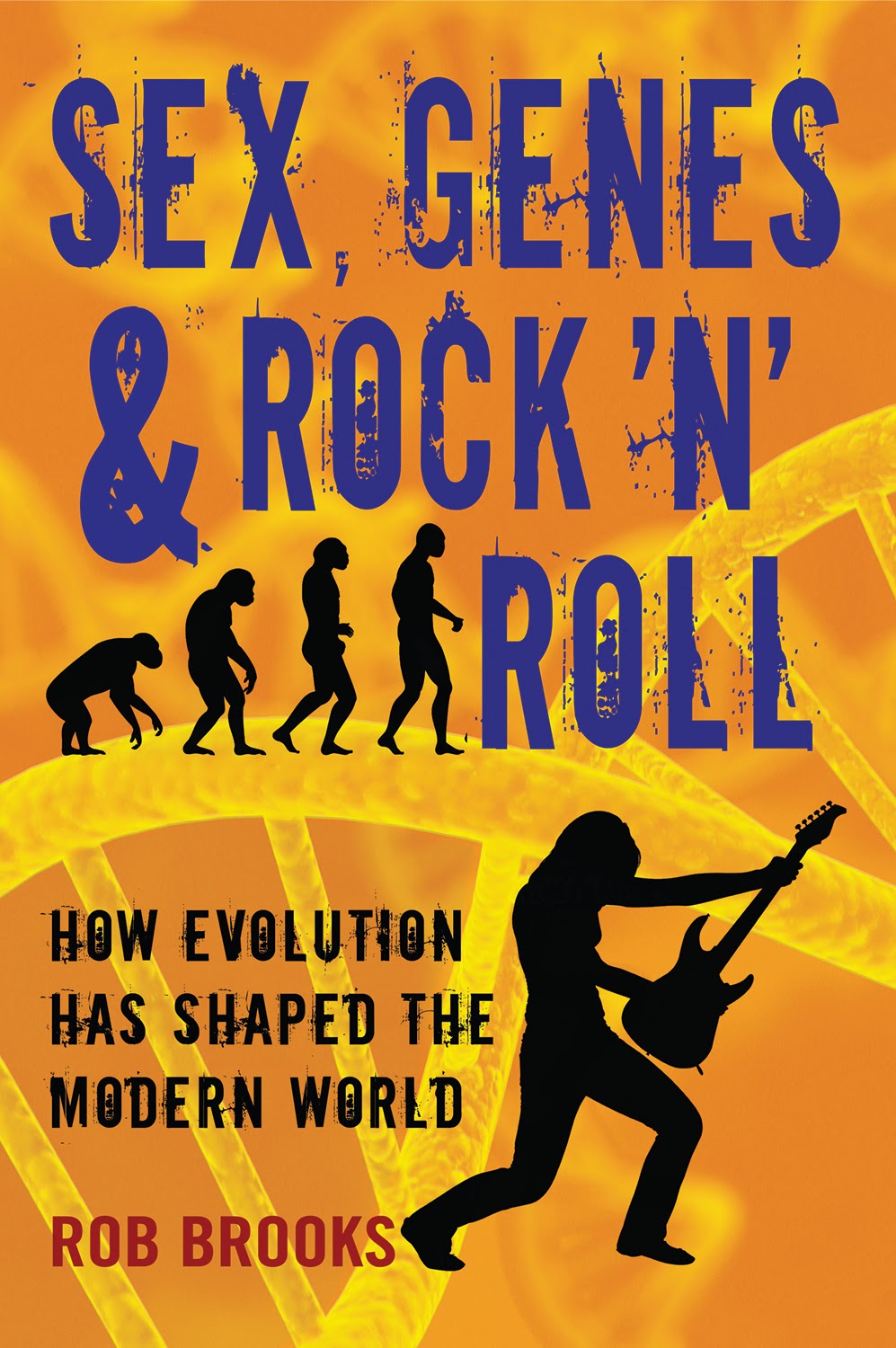
Sex, Genes, and Rock 'N Roll: Dr. Rob Brooks talks about how evolution has shaped the modern world


My guest today is an evolutionary biologist "who thinks about sex for a living": his job consists of exploring "the evolutionary and ecological consequences of sexual reproduction." Dr. Rob Brooks, a professor at the University of New South Wales, in Sydney, Australia, studies how evolution shapes many aspects of our life, like mate choice, the costs of being attractive, the reason animals age, and the links between sex, diet, obesity and death.

I just finished reading Dr. Brooks' book Sex, Genes & Rock 'n' Roll: How Evolution Has Shaped the Modern World, a fascinating journey into human habits and cultures seen under an evolutionary perspective, and I thoroughly enjoyed it. I confess it also left me pondering with some questions, and that's why I am so thrilled to have Dr. Brooks as a guest today on CHIMERAS!

EEG: Some of the research interests listed on your UNSW page are: "the evolution of mate choice, the costs of being attractive, sexual conflict, the reason animals age and the links between sex, diet, obesity and death." Besides publishing important papers, you turned these topics into a beautiful book that, without ever getting technical, describes who and what we are in evolutionary terms, weaving in genetics and animal studies. When and how did you get the idea to write Sex, Genes and Rock n' Roll?

RB: I’ve long wanted to write popular science books about evolution that both entertain and educate people who don’t get to think about evolution and at the same time to present new ideas for how my field of research might help us understand who we are. I especially wanted to demolish this reflexive habit we have of seeing things as either cultural or biological in origin. It’s an obstacle that prevents the biological and social sciences from learning from one another. So in early 2009, I was approached by Stephen Pincock, then a publisher at NewSouth, because he had heard about my research and wanted to commission some science books. He helped me get over that initial hurdle of conceiving the book and getting a contract to write it. It was very exciting, because without his nudge I might never have started writing.

EEG: Your book touches many issues in our society: obesity, excessive consumption, teenage excess, disruptive behaviors, etc. For each, you make connections to evolution and reinterpret them under an evolutionary point of view. I can't help but wonder, though, how much "progress" has skewed evolution over the past 200 years. For example: many diseases no longer affect us thanks to vaccines; many "fit" couples choose not to have kids; and mostly, our "self-consciousness" has led us to change the course of selection in many instances. Your take, though -- correct me if I'm wrong -- is that these very same behaviors can be explained from an evolutionary point of view. Is human kind, then, like Oedipus who ends up fulfilling its fate by trying to escape it? Or is it more that we "are what we evolve into" no matter what we do ... ?

RB: We very much “are what we evolve into”. The thing about evolution is it is a consequence of a banal historic process whereby some individual leave more descendants than others. Or more precisely some genes leave more copies of themselves than others. So you can tell where a population has been, but it is impossible to tell where it’s going to go. We can make rough predictions, based on which kinds of traits are related to reproductive success today, but the environment is ever-changing, and the relationships are complex. We know, for example, that there has been rapid adaptation to high carb diets since the industrial revolution, even in 4-5 generations, and so I would predict – if compelled – that various adaptations by which people avoid the foods that cause obesity, shed excess energy and also cope with the extra weight might currently be under selection. If the current obesity crisis persists, we will almost certainly adapt to it. But nobody can be quite sure how.

Yes, medicines alter the way selection operates, but they too are part of the environment now.

EEG: But take for example the natural tendency that we have, as a species, to maintain a 1:1 male to female ration, and yet the numerous disruption introduced by human behavior. It seems to me that the 1:1 male to female ratio is a stable point and no matter what we do (for whatever reason), there are forces that inevitably bring us back there...

RB: It’s true that the ‘Fisher condition’ restores population sex ratios to near parity in a very stable way, but the Trivers-Willard process means it can be highly adaptive for skewed sex ratios under certain economic conditions. And unfortunately the economic cues can persist and give effectively the wrong message as they are doing in northwest India, where so many families are behaving like the extreme high-caste individuals with ever-increasing tragic consequences. It will probably take a generation for the lack of prospects for sons to turn into a cultural change that restores value to daughters sufficiently.

EEG: What will your next book be about?

RB: I’m writing about the conflicts inherent to sex and why they make sex and family life so ridiculously complicated.

EEG: I'm already intrigued. I'll be on the look out for your next book!

If you, too, don't want to miss Dr. Brooks' next book, you can check out his website or follow him on Twitter. Dr. Brook also blogs on The Conversation.

Friday, May 9, 2014

Prying minds with mind-blowing optogenetics


Did you know there was such a thing as optogenetics? The idea alone completely blows my mind:
"Optogenetics uses light to control neurons which have been genetically sensitised to light. It is a neuromodulation technique employed in neuroscience that uses a combination of techniques from optics and genetics to control and monitor the activities of individual neurons in living tissue to precisely measure the effects of those manipulations in real-time. The key reagents used in optogenetics are light-sensitive proteins." [Wikipedia]
The "light sensitive proteins" mentioned above are a family of proteins, called opsins, that are found in the photoreceptor cells of the retina. These proteins are responsible for converting light (photons) into electrochemical signals.

So, in layman terms, the idea behind optogenetics is that if we can deliver these opsin proteins into the neurons, making them sensitive to light, we can then use light to control the neurons themselves. This is used to understand the function of certain cell types in the brain. How do you deliver the proteins to the neurons? Using viral vectors, of course. When injected into the brain, the viral vectors infect the neurons, delivering the opsin genes. These genes make the neurons sensitive to light and can therefore be activated or silenced using optical fibers delivering light. It sounds very much like science fiction, but basically this enables researchers to control neurons using optical fibers.

Source: Lumencor
This optic stimulation is limited to very small areas of the brain. Not only that. The way neurons react to light depends on the frequency used to stimulate them. Animal studies have shown that light stimulation of the ventral segmental area can induce depressive-like behaviors at 20 Hz, whereas increasing to 30 Hz (in a different study) elicited antidepressant effects.

Because there's a whole family of opsin proteins, current research is aimed at understanding which ones work best depending on the experimental setting and circumstances. For example, different opsins can elicit neurons at different wave lengths, and when there's no overlap between the two spectra, two different opsin proteins can be used simultaneously to obtain two different outcomes on neural activity. Pushing this even further, genes coding for these proteins can be mutated to change their wave-length and frequency sensitivity and can be optimized for certain experimental settings.

Researchers use optogenetics to identify brain circuits that control emotions like fear, depression, and anxiety, and all the areas involved in those circuits. Previous methods included local lesions, pharmacological treatment, and electrophysiological studies, but these didn't give complete control on the temporal window like light stimulation does, which can activate or inhibit neurons at a very precise moment. It's fascinating stuff that I confess I don't completely understand myself as it is not my field, so I welcome the input from any experts out there willing to share their view and any literature recommendations!

On a side note, CHIMERAS is now at $.99 for a limited time only! (Grab a copy if you love mysteries and science).

[1] Belzung C, Turiault M, & Griebel G (2014). Optogenetics to study the circuits of fear- and depression-like behaviors: A critical analysis. Pharmacology, biochemistry, and behavior, 122C, 144-157 PMID: 24727401

ResearchBlogging.org

Wednesday, May 7, 2014

What exactly is grit ?


This is a monthly event organized by the Insecure Writer's Support Group. Click here to find out more about the group and sign up for the next event.

Some time ago my friend Cristina emailed me and said: "Forget IQ and forget money. The key to success is grit."

Of course, I'd never heard of the word "grit." So I looked it up and learned from Wikipedia that grit is a personality trait:
Grit in psychology is a positive, non-cognitive trait based on an individual’s passion for a particular long-term goal or endstate coupled with a powerful motivation to achieve their respective objective. This perseverance of effort promotes the overcoming of obstacles or challenges that lie within a gritty individual’s path to accomplishment and serves as a driving force in achievement realization. Commonly associated concepts within the field of psychology include "perseverance," "hardiness," "resilience,” “ambition,” “need for achievement” and conscientiousness.
My friend had just watched Angela Duckworth's TED talk on grit. Duckworth is an associate professor at the UPenn, where she studies "competencies other than general intelligence that predict academic and professional achievement."

There are many online articles about grit being the key to success:

Jonah Lehrer defines grit on Wired Science.

Margaret Perlis spells out five characteristics of grit.

Duckworth's definition of grit is "perseverance and passion for long-term goals," which is also the title of a 2007 Journal of Personality and Social Psychology paper she co-authored. Citing from that paper:
"Grit entails working strenuously toward challenges, maintaining effort and interest over years despite failure, adversity, and plateaus in progress. The gritty individual approaches achievement as a marathon; his or her advantage is stamina."
Why am I citing a psychology paper in today's Insecure Writers Group post? Because I believe it was one of our group members, Susan Kaye Quinn, who said, "Self-publishing is a marathon, not a sprint. Whatever the route that led you to indie publishing, whatever the story you want to tell, you need grit to make it successful. And you know what? That's excellent news. Because agents and editors judge your story based on marketability, but, ultimately what determines the success of your work is your willingness to make it succeed -- and that's just another definition of grit.

I know many of you have the grit it takes to succeed. I've seen it: new writers who rise through the Amazon rankings and stay up there because they work hard and they keep pushing. Go you. Don't give up. Take your daily dose of grit as your medicine and keep pushing.

Monday, May 5, 2014

Seeking answers to big questions: science fiction author Lacerant Plainer talks about his journey in science and writing.


A few weeks ago I had the pleasure of making a book cover for science fiction author Lacerant Plainer's latest Novella, Orange Rock. Lacerant is an active member of the G+ community, where he posts the coolest science stuff: fellow sci-fi writers will find his posts very inspiring, so check out his stream on G+!

Lacerant's work explores the future of human kind as evolution leads us to new technology and the longing to explore new worlds. At the same time, as we exploit the limited resources of our planet, could it possibly bring us to the brink of a self-inflicted extinction? In Lacerant's own words:
"I write about transhumanism, near as well as distant futures, and like to dream of the possibilities that face us. We are uniquely poised to take advantage, or face the consequences of our actions in the near term and this fascinates me."
I'm honored to have Lacerant Plainer as my guest here on CHIMERAS today to share his thoughts on science and writing. Welcome, Lacerant!

EEG: Can you tell us what your background is and where the love for science comes from?

LP: I have a science background (Chemistry and Physics) and pursued further studies in Chemical technology. But my love for science and science fiction goes back much further. I was always interested in the science of how things work.

I read a lot as a kid. We couldn't afford to buy books, so I used to visit a library near my home and sit there reading. To my surprise there was a world of possibilities of conjecture... in fact whole solar systems, galaxies and universes to discover. I read voraciously... right from an age of seven, I was reading Isaac Asimov and Frank Herbert. It was fascinating. I couldn't stop.

I read all genres earlier, including Jennings, William, Enid Blyton etc. I moved rapidly onto books by Arthur Hailey, Alistair Mclean, Leon Uris etc.... But over time, Science fiction chose me. My first science fiction book was one by Edgar Rice Burroughs. I can't remember the title for the life of me. But science fiction captivated me since it was a vast canvas. It offered the dreamer in me a canvas to paint. I see the stories I write in my head. I actually feel the afternoon sun on my neck, the acrid smell of the desert. The sound of the sand rasping through the air as a vehicle moves through it....

Science was a natural choice for me. It was logical, was all around us, and it would be unthinkable for me to study anything else. But my real understanding only took place later, when I taught kids the fundamentals.

EEG: I know science inspires you, and I love what you wrote in your profile: "We are uniquely poised to take advantage, or face the consequences of our actions in the near term and this fascinates me." I feel the same dichotomy, as on the one hand I marvel at the powerful ideas human kind has produced over time, while on the other hand those same powerful ideas have led us to exploit the precious resources we depend on. When you think about the future (besides being inspired to write stories), do you think we will prevail or do you think we're doomed? And why?

LP: This is a tough question, but let me attempt to tackle it. In my view, the difference between the rich and poor and average person is much more pronounced than in the last 50 years. On the other hand, the world is more connected than ever in the history of humans. Science and technology is on the cusp of some path-breaking stuff... in almost every discipline. In fact, we are understanding that the different streams are intimately connected. If one follows the money which makes this possible in terms of research and science, one does see how power will ultimately be concentrated in the hands of a few (especially since governments are abdicating the position they held in science earlier). Whether the powerful will be benevolent or otherwise, will depend on a number of factors. The ability to transform ourselves (cybernetics, transhumanism, genetic manipulation) offers a way to direct evolution.

I was working on a book which addressed this, looking into the future required extrapolation... but if one was to make an educated guess, I would assume we would spawn a number of different 'types' of humans. Some may not be called human at all. The privileged class could well become immortal or long living. Everyone else would be modified to do their job better. This is actually my optimistic scenario. If one was to assume we don't take care of the planet's tendency for warming, it would be catastrophic. Maybe another species would arise.

EEG: Most of your stories are set in the future and/or worlds outside our solar system. If you were to travel outside our solar system, what things would you hope to see? What questions would you try to answer?

LP: (Laughing)... I would probably not get a chance to travel outside our solar system. Not in my lifetime. I am not an explorer anyway, and unless I had a exoskeleton, it would be well nigh impossible. The answers we are seeking are going to be answered by science, and travel will add to our capabilities as a species and making resources available to us. What I would like to know really are the big questions. What happened before the big bang. Are there parallel universes. Why does life organize itself the way it does. Why are we still not just cells.

Writing about space travel is only a setting. The journey to getting to such a stage is what fascinates me.

EEG: Tell us about your last work, Orange Rock: what was the inspiration? do you plan any sequel?

LP: Orange Rock was actually something I wrote some time back. I've written about 3 other books since, but for lack of a good editor, I've been stymied.

I was reading about entanglement and teleportation and the science behind it. But the real idea came from the fact that humans are extremely clannish. We huddle on rocks and defend it with our lives. Everyone else is an outsider and needs a Visa to come sit on our rock. Our outlook makes me despair sometimes. It's all so artificial. And people would die for it. It makes one wonder.

I've often been told Science Fiction writers are so pessimistic, but one has to just look at the way humans behave and the way we can subvert the best of intentions and ideas to understand that extrapolation will lead to a dystopian future. I try to get the best case scenarios within what I can see ahead, but it's not always easy.

EEG: I agree. It's not about being pessimistic, it's about analyzing the possible consequences of our current actions -- and they don't always lead to "happily-ever-after" scenarios. Thanks so much, Lacerant, for being with us today and for sharing your thoughts on not just science and writing, but also on the possible futures that may or may not await us.

You can read Lacerant's flash fiction and follow his work on his blog, www.lacerantplainer.com

Saturday, May 3, 2014

Bug shooting tips from macro photographer Shane Williams, a.k.a the "Bug Whisperer"

He's the "Bug Whisperer" over on G+, and if you haven't seen his beautiful work yet, you should. Here's a sample of what you've been missing:


Based in Adelaide, Australia, Shane Williams is a fantastic macro photographer who specializes on shooting insects. You can find his work also on Flickr and 500px.

Today Shane is my guest here on CHIMERAS to teach us some of his "tricks of the trade" on how to shoot bug macros. Welcome, Shane!

EEG: First off: why do you shoot mostly bugs?

SW: I've always been interested in nature and animals and enjoyed trying to capture these subjects even early on when I owned point and shoot cameras. Also, being a bit of a tech nerd I’m very interested in the detailed specifications and capabilities of cameras as digital technology advances.

I progressed to owning Canon Powershot models which were great all rounder cameras as they had some of the longest zoom ranges in the prosumer market yet also had the ability to focus to 0mm (meaning you could actually put the subject against the front glass of the lens and the camera was still able to focus on it)

I suppose I've always been drawn to capturing things not viewable to the naked eye whether this be at the extreme zoom range or the opposing macro end and as I started playing around with shooting macro images I became more and more fascinated with the details the images unveiled.

The more proficient I became with the technical aspects of capturing living subjects the more the feeling of awe and fascination grew for me as more and more details I was previously unaware of and had never seen became viewable in the shots I was capturing. The complex structural anatomy and beauty of Arthropods when seen at lifesize or greater magnifications was giving me an insight into a whole new world and multitude of complex micro ecosystems that many people are either unaware of or completely take for granted.

I was fascinated that all this could be occurring in a single bush in any residential street front garden! I began to find it extremely challenging  to shoot moving live subjects and once again dived into the technical aspects of how to achieve sharp, well composed, well lit images now leaning more toward not only producing an acceptable image but also striving to give it some artistic merit as for me it was also very important not only to try to capture good images but also present them in a way that to a casual observer or someone who may have a natural aversion to Bugs or Spiders etc may gain a new appreciation for them through my images.

In essence macro photography of Arthropods is exciting to me on many levels, from the technical aspects of producing a good image, to the primal instinctual urge that’s satisfied by “stalking, hunting” and coming to learn the habits of you “prey” and an ongoing desire to expose these lesser known species to people in the hope that they gain even more of an appreciation for their place in the natural world.

EEG: You've recently acquired a Canon MP-E 65mm, which is a very unique lens that can enlarge a subject up to five times. Such amazing technology comes with a shallow depth of field and other difficulties that one has to overcome when using it. Before you had this lens, you were shooting macros using a 50mm lens fit with extension tubes. Can you compare the two set-ups? What are the pros and cons of each?

SW: I initially started shooting macro with a 50mm1.8D prime lens on a set of Kenko extension tubes, later on progressing to dedicated macro lenses and finally to a specialist lens the Canon Mp-e65mm. Both set-ups provide extremely sharp images, as the Mp-e is essentially just a 65mm prime lens reversed with bellows built in anyway so the glass on both lenses produces exceptional sharpness. The advantages of the 50mm on tubes is of course price, coming in at less than a quarter of what an Mp-e will set you back.

You also have more flexibility at the wider end with the 50mm as you can go from infinity without any tubes up to 1:1 or greater by adding \ removing tubes or other methods whereas the Mp-e being a specialty macro lens designed for very close up photography starts at a magnification of 1:1 and moves in to 5x. With many larger subjects such as Butterflies, Dragonflies, larger Spiders etc you cannot even fit the entire subject in the frame at 1:1 so you’re left trying to compose an interesting shot from a partial body image or not bothering to shoot the larger subject at all with the Mp-e. While at the wide end the Mp-e can be limiting, there’s nothing that compares when it comes to magnification capabilities as the lens extends smoothly from 1x to 5x magnification retaining the same sharpness throughout.

The most important factor when shooting any image of course is light, and this is no more apparent than in macro flash photography. Trying to achieve fast enough shutter speeds to freeze moving Arthropods while using small enough apertures to provide adequate depth of filed (extremely limited due to the magnification in macro shooting) is almost impossible without using a flash to provide additional lighting. They key to sharp well lit macro images is to have your light source close enough to your subject to provide the shortest burst of light possible (the light emitted by your flash becomes your effective shutter speed, so the quicker the better) while also producing well diffused lighting without blown out highlights or bright spots in the image.

This is very difficult to do and there are very few specialty retail solutions available to help, so many times customised options are the only way one can achieve good results. There is a specific twin head flash unit called the MT24-ex manufactured for the Canon Mp-e65mm (it also fits the 100mm macro) which clips onto the front of the lens allowing your light source to travel with the lens as it extends (the Mp-e extends some 5 inches as you progress through the zoom range) which is invaluable as little adjustment is required whether you are shooting at 1x or 5x. It is again a very expensive piece of kit costing almost as much as the lens itself and still needs a lot of customised diffusion before it produces pleasing light but it’s the best light solution I have used for macro yet.

This is another advantage of the Mp-e as there are no equal solutions for a tube set-up and much more customisation is usually required to produce a flexible lighting solution. In summary if price is the main focus and an Mp-e set-up is out of the budget range great results can be achieved with a 50mm on tubes option as long as you can manufacture a suitable flash solution to light your subject.

I would also recommend a 50mm on tubes if your interest mainly lays in larger subjects or farther out compositions and a lot of flexibility at that wider end. (although not technically “macro” as macro means an image at lifesize “1:1” or greater, many people shoot at this “close up” range for the bulk of their shots). I would only recommend the Mp-e lens for someone who is an experienced macro shooter who’s already used other set-ups and wants to be able to produce images greater than 1:1 magnification and can afford to buy not only the lens but again a lighting set-up that will do it justice as well.
It can be a very challenging lens to use, is very expensive, and is limiting at the wide end, but no other lens gives you the flexibility to zoom all the way from 1x to 5x on the fly and produce as sharp images when handled well.

EEG: What kind of flash set-ups do you use and what do you recommend in particular for macro photography?

SW: Specifically regarding the flash set-ups I use there are a few variations depending on which lens I’m using at the time and the subjects \ conditions on the day.

As the subject is so close to the lens in macro photography you don’t need a very powerful flash to provide sufficient illumination for good exposure, so smaller and (sometimes!) cheaper units are adequate. For the Mp-e65mm I prefer the MT24-ex twin head solution and have put a lot of work into making customised diffusers which fit onto the flash heads to diffuse the light as well as possible while still retaining fast enough shutter speeds and decent contrast in the image.
When shooting with tubes or other macro lenses on my Nikon bodies I just use the smallest cheapest flash available from Nikon, the SB400.

I diffuse this with either cone shaped diffusers I place over the flash head or with pop up fabric diffusers I hold in front ot the flash which allow me to angle the light and adjust the distance between light source, diffusion, and subject for different results. The requirements for macro flash photography aren't too different to the main elements in other styles. Try to provide good levels of light for a well exposed image without blown out highlights, bright spots or harsh shadows.

As long as you can produce light preferably at a close distance to the subject to shorten the effective shutter speed (and also conserve power out put meaning faster refresh times and longer battery life), it really comes down to diffusing the flash to produce the light you find most appealing for the subject you’re shooting. Arthropods vary substantially in their reflectiveness as well, so things like Butterflies or Spiders you may find you can diffuse the light less and retain more punchy contrast but when faced with things like Lady Bugs or Ants which are smooth and highly reflective you need to add diffusion so as not to produce very harsh hot spots in the image which can be albeit impossible to rectify in post processing.

A quick Google of “macro flash diffuser” on the web will provide countless examples of options for flash diffuser designs and a lot of trial and error is usually required before you get the results you’re after. I have been heavily influenced and inspired by many shooters along the way and only hope I can do a portion of the same for other’s looking to get into macro photography in the future. I have gleaned countless pieces of great advice and guidance from people like Mark Plonskey, John Kimbler, Popumon Papulop and others through their writing, comments, and by observing the images they produce. I think it’s one of the most important things you can do no matter what you choose to shoot: be humble, always learn what you can by looking at other peoples work, always be a student and realise how far you have to grow,challenge and push yourself to progress, create, and push your boundaries as an artist.

Most importantly have fun!

EEG: Thanks so much, Shane, for sharing all these tips with us today! And yes, having fun is indeed the most important part. 

For more eye candy from Shane, check out his fantastic galleries on on Flickr and 500px.

Thursday, May 1, 2014

Carnival of Evolution, Edition #71: A Theory of Evolution or the Evolution of a Theory?

Today I'm hosting the 71st edition of the Carnival of Evolution, a monthly event where to share and discuss recent articles and blog posts about evolution. The next edition will be hosted by Adam Goldstein over at The Shifting Balance of Factors blog. You can submit post links on the Carnival Facebook page.

We start with a question that's more complex than it sounds: is modern evolutionary theory "Darwinian"? John Wilkins, at Evolving Thoughts, digresses on the positive and negative meanings that the word "Darwinian" has garnered over the past decades. Unlike religion and doctrines, theories change and evolve as our understanding of phenomena deepens and the technology we use to measure and probe gets better. As such, the theory of evolution has evolved and grown, too, since Darwin set its foundations.

A lot has happened since Darwin published On the Origin of Species. Today's evolutionary theories are drawn from the conjoint effort of many fields: genetics, populations genetics, phylogenetics, epigenetics -- and the list goes on. (And no, phylogenetics do not support intelligent design, despite what some might argue, as reported by David Morrison over at The Genealogical World of Phylogenetic Networks.)

Many contributions to the field come from theoretical models, like the one presented in a recent paper by Roesti et al. (Mol Ecol., 2014, Mar 18). Parallel adaptation is the phenomenon when species from a common ancestor adapt "in parallel" to similar environments. This phenomenon is common in fish: species like the threespine stickleback for example have readapted to river water from marine ancestors. Marius Roesti and colleagues have modeled this parallel adaptation through a "twin-peak and valley model", which he discusses on the Eco-evolutionary dynamics blog.

"Born" in 1942, when CH Waddington coined the term fusing the words epigenesis and genetics, the field of epigenetics is also gradually reshaping the way we think of evolution. Epigenetics makes us rethink heritability, as some changes in gene activity can be passed on to future generations even though they are not encoded in the DNA. In fact, recent studies indicate that some traits can be inherited through gut microbiota.

One of the central ideas in evolutionary theory is fitness. Different phenotypes have different fitness, which is measured in the average number of offspring. Imagine a set of genetic loci, each of which determines a certain phenotype. Any mutation at any one locus changes the phenotype and comes with either a fitness cost or a benefit. One can represent this through a "fitness landscape", a bi-dimensional plane with peaks and valleys: each point on the plane represents a phenotype and the z-axis represents its fitness. With this set-up, the way a phenotype has evolved accumulating a certain number of mutations throughout evolution can be represented as a path in the landscape. Using fitness landscapes, Bjørn Østman and Randy Olson created a video to visualize evolution in action on the Beacon Center blog. You can see more fitness landscapes demonstrating sympatric speciation ("the process through which new species evolve from a single ancestral species while inhabiting the same geographic region") on Randy Olson's blog.

As organisms evolved, some characteristics got lost: "nearly every animal phyla contains at least some species that consistently regenerate all or certain tissues and structures," yet this ability is lost in humans. Tissue regeneration is a fascinating field to study as its mechanisms could help us treating neurodegenerative disorders, spinal cord injuries, and limb amputations. In a blog post on the Beacon, Shawn Luttrell discusses his research at the University of Washington in understanding the morphological and genetic mechanisms of tissue regeneration in Ptychodera flava.

The fact that theories evolve means that definitions need to evolve, too. On his blog, Bjørn Østman discusses how often we disagree on simple definitions, as is the case with "species", for example, which he proposes to substitute with a "criterion" instead of a "definition."

What does Darwinism mean to you? You can join the discussion by filling the survey here.

If you're unsure about the answer, check out the historical quotes Joachim Dagg listed on his blog, Ecology & Evolution Footnotes.

And finally, let's not forget evolution's building blocks: this past Friday, April 25, was DNA day. So, happy DNA day everyone! Until next time!

EDIT: Apparently there was a misunderstanding in the new submission process and I had missed some of the links people submitted. I apologize for that and I'm listing them here below as I have just seen them and haven't been able to read the articles: